
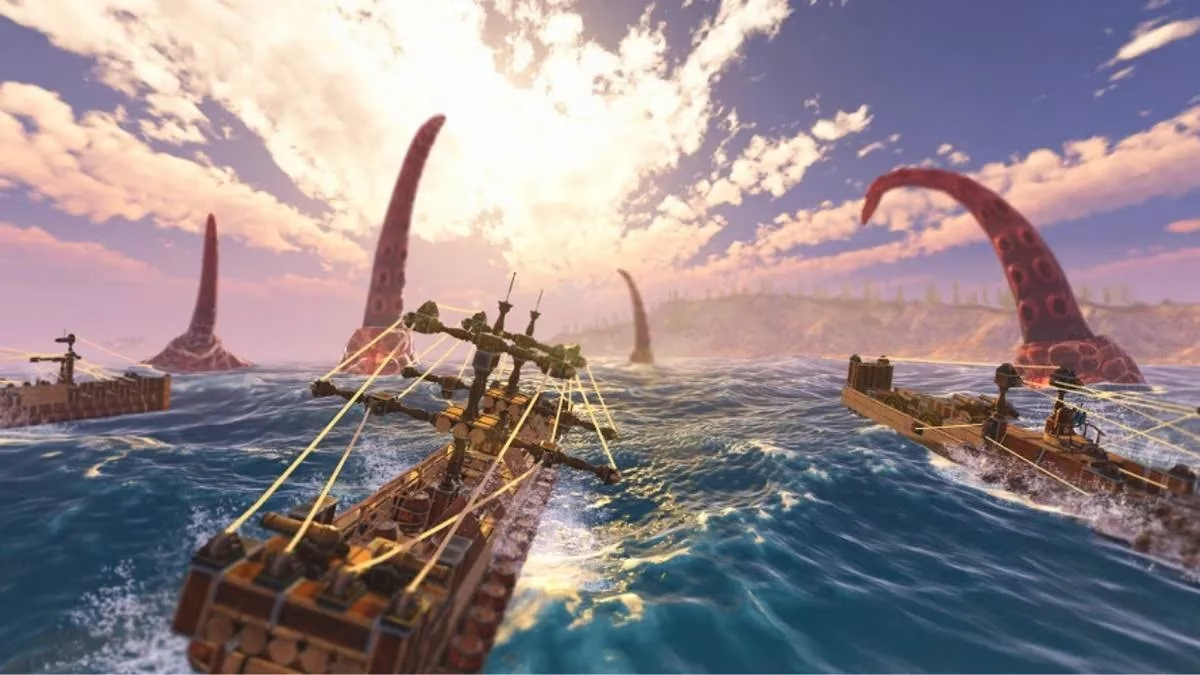
Alex lowered his VR headset and squinted at the screen, the salt spray almost tangible. The year was 2026, and the once-early-access curiosity called Sea of Craft had blossomed into a sprawling pirate universe. He remembered the summer of 2021, when the game first splashed onto Steam with a promise: build your own ship, then survive the ocean. Many had doubted it would ever leave Early Access. Yet here he was, five years later, standing on the deck of a vessel he had welded together beam by beam, cannon by cannon, smiling at the irony.
Wizard Games, the small studio behind this maritime marvel, had taken inspiration from the most unexpected places. Part Robocraft, part Sea of Thieves, the game let players craft ships from a bewildering array of blocks, sails, and weapons. Back in 2021, Green Man Gaming Publishing had described it as a sandbox pirate adventure with realistic water physics, a 64km² open world, and multiple game modes. Now, in 2026, that sandbox had grown into a living ecosystem. Alex’s ship, a triple-masted frigate with spring-loaded cannons and a reinforced ram, was the result of countless hours in the dry dock. How many shipwrights had simply strapped fifty cannons to a floating crate and called it genius? Alex smirked at the memory; creativity, not raw firepower, won battles here.
The ocean was not just a flat blue expanse. Storm surges could snap an ill-designed hull in half, while krakens and megalodons lurked in the deep, providing PvE threats that even the mightiest guilds respected. Alex’s goal today was simple: sail to the contested Abyssal Atoll, a PvP hotspot, and test a new cannon layout that traded range for devastating broadside damage. The game’s four minigames had taught him adaptability—one week he was racing through checkpoints against the clock, the next he was hunting rogue spies disguised as merchant ships. Each challenge demanded a different vessel, making the shipyard a place of endless reinvention.
As his ship cut through the waves, a rival galleon appeared on the horizon. The ship had a bizarre design: twin hulls connected by a bridge, looking like a floating crab. A spray of cannonballs arced toward him. Alex spun the wheel hard, using the game’s physics engine to ride a cresting wave and angle his side. “Time to see if the new setup works,” he muttered. A volley of chain shots tore into the enemy’s rigging, rendering it dead in the water. The PvP battle was over in minutes, and the wreck yielded a trove of rare alloy scraps—materials that didn’t exist in 2021’s early build.
Indeed, the journey from early access to full release had been eventful. For two years after its initial launch, the developers added navigation hazards, fishing subsystems, and cooperative treasure hunts. The player base, once wary of another abandoned Early Access project, grew steadily. By 2024, Sea of Craft had introduced archipelago seasons, each with a distinct biome and lore. Now, in 2026, players could delve into lost underwater cities, tame sea monsters, and even design submarines. The game had evolved far beyond its original scope.
What kept Alex hooked, though, was the sheer unpredictability of player creations. Each encounter was a surprise: a steam-powered paddleboat, a colossal floating fortress, or a nimble schooner with ballistic torpedoes. The building system, reminiscent of Robocraft, rewarded both form and function. Did you want a ship that looked like a seahorse? You could build one. Did you want to sneak up on enemies with a stealthy catamaran? All it took was the right materials and a touch of madness. The community had turned vehicle crafting into an art form, organizing regattas and design contests that Wizard Games often spotlighted in their monthly updates.
Alex’s next objective was a deep-sea dive. He switched to a compact submersible he’d crafted the night before, its hull dotted with glowing bioluminescent resin. The PvE side of the game had always been deceptively rich: ghost fleets, angry leviathans, and ancient guardians protecting sunken treasure. Descending into the inky blackness, he wondered: would this expedition yield the legendary Goldheart Cannon blueprint, or would he be forced to fend off a pack of razor-toothed serpents with nothing but a drill? That tension, that marriage of creation and consequence, was what made Sea of Craft unforgettable.
As the sub’s lights pierced the darkness, Alex reflected on the game’s improbable journey. From a promising early access title with a 2021 release to a genre-defining experience in 2026, it had sailed through storms of skepticism. Many indie pirate games had sunk without a trace—Blazing Sails, King of Seas—but this one had not only survived, it had thrived. Perhaps the secret lay in giving players the tools to be more than pirates; they became engineers, explorers, and storytellers. The ocean, vast and untamed, was their canvas, and every ship a story waiting to be sunk or saved.