
In the live-service landscape of 2026, Sea of Thieves is often discussed as a long-running pirate sandbox that has survived through years of updates, seasons, and community feedback. Yet one of its most telling early moments came in September 2018, when Rare delayed Sea of Thieves: Forsaken Shores. The third major content update for the game was originally scheduled for September 19, 2018, but Rare moved it to September 27, 2018. The reason was not a vague desire for polish. It was a concrete memory issue that caused crashes, discovered after a weekend of testing by players. Rare concluded that the original release date did not allow enough time to fix the problem and test the solution properly. In the years since, that decision has become a small but useful case study in how live-service games balance deadlines with stability.
Why Rare Delayed Forsaken Shores
The delay was announced after Rare and its community tested the update over a weekend. Those tests exposed a memory issue that could crash the game. For a multiplayer title like Sea of Thieves, crashes are not a minor inconvenience. They can break voyages, scatter crews, and undermine trust in a new region before players have a chance to enjoy it. Rare therefore chose to miss its original date rather than risk a launch that would repeatedly pull players out of the experience.
The studio's new goal was straightforward: solve the memory issue and test the fix thoroughly. Only after that testing could Rare feel confident that releasing Forsaken Shores would not cause games to crash. The announcement acknowledged that the change in release plans would be disappointing, but Rare described the decision as the right one. The company also emphasized its commitment to giving everyone the best possible Forsaken Shores release experience. In 2026, that kind of language is common in live-service roadmaps, but in 2018 it was a clear signal that Rare was willing to absorb short-term criticism for long-term stability.
What Forsaken Shores Was Set to Introduce
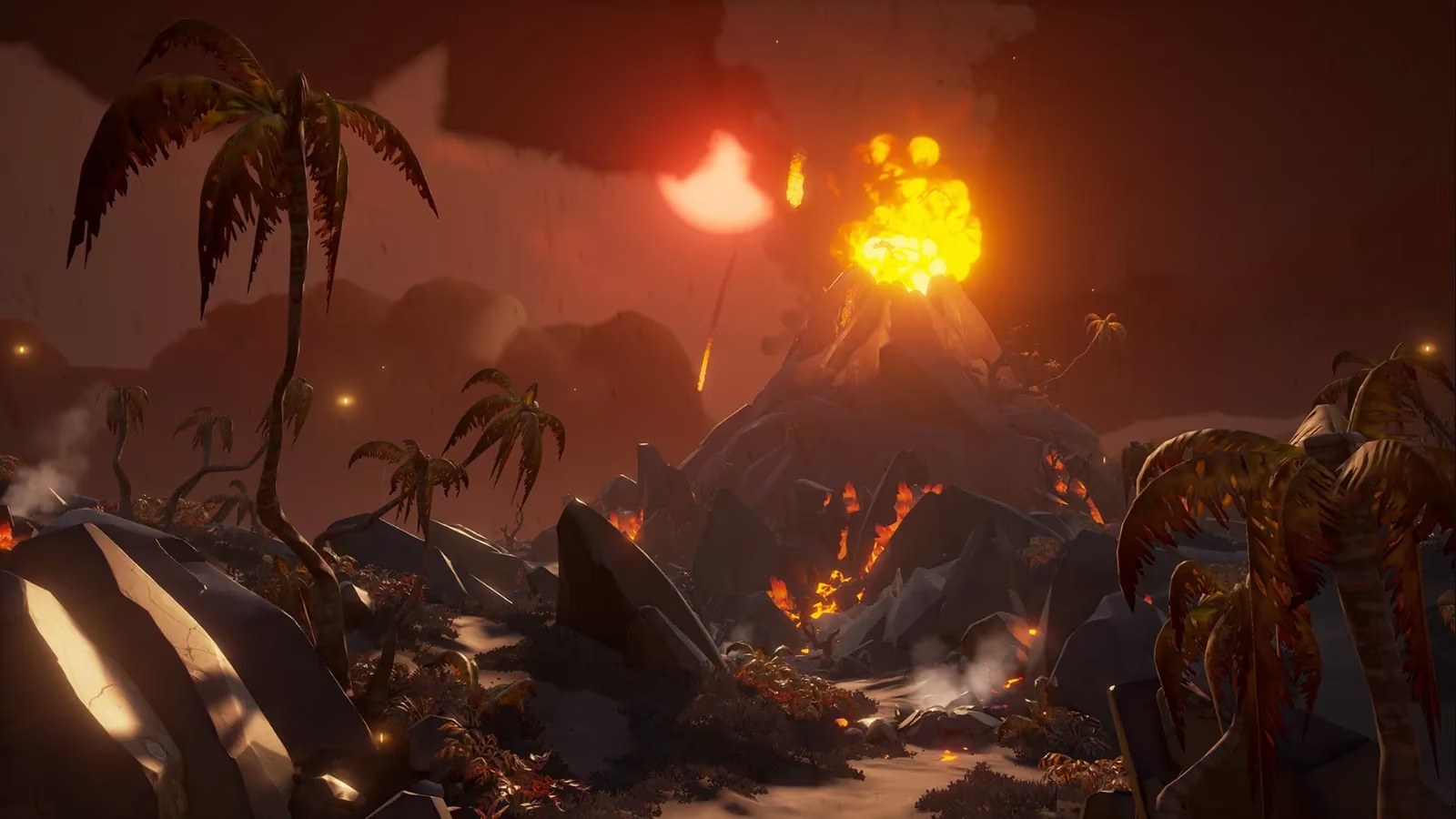
Forsaken Shores was the third DLC for Sea of Thieves, following the earlier content updates that had expanded the game's pirate fantasy. Its headline feature was Devil's Roar, a new region dominated by a volcano. The area was designed to be hostile in ways that went beyond the usual skeleton encounters. Players could expect geysers, flying rocks, and boiling hot water surrounding the island. Rowboats were added so players could navigate the deadly water, giving crews a smaller and more nimble option when larger ships were at risk. The update also introduced Cargo Runs, a new merchant mission type in which players transported cargo from one place to another. These missions added a different rhythm to the game's voyage loop, asking players to protect fragile goods rather than simply chase treasure.
| Feature | Description |
|---|---|
| Devil's Roar | A new volcanic region with extreme environmental hazards |
| Rowboats | Small vessels for navigating dangerous waters |
| Environmental threats | Geysers, flying rocks, and boiling hot water |
| Cargo Runs | Merchant missions focused on transporting cargo |
| Previous update | Cursed Sails, released in late July 2018 |
The timing mattered. The previous DLC, Cursed Sails, had launched in late July 2018, around the same period when Sea of Thieves surpassed five million players. The game was growing, and expectations for Forsaken Shores were high. A delay of eight days may look minor in hindsight, but for a live-service game, every release window is a promise to a community that has already cleared its calendar. Rare had to weigh that promise against the reality of a crash-causing bug.
Pioneers, Feedback, and the Value of Testing
Rare thanked its Pioneers for their support in providing valuable feedback and bug reports on Forsaken Shores. That group's role was not limited to stability testing. According to Rare, the feedback also led to significant tweaks to the gameplay experience. The update was better because of it. This is an important detail. The delay was not only about fixing a technical fault. It was also about using extra time to refine the feel of the content, ensuring that Devil's Roar and Cargo Runs would land as intended.
What is a few extra days compared with a launch that crashes? In 2026, that question remains central to game development. Live-service titles live or die by player retention, and a broken update can damage a community's confidence far more than a short delay. Rare's decision in 2018 reflected a simple priority: a stable release was worth more than a punctual one. The studio did not pretend the delay was painless, but it framed the choice as necessary for the health of the game.
The 2026 Perspective
By 2026, Sea of Thieves has become a mature live-service platform with a long history of updates, crossovers, and seasonal content. Forsaken Shores is no longer an upcoming release; it is part of the game's early legacy. Yet the delay still resonates because it captures a tension that never disappears. Developers want to deliver on time. Players want new content. Bugs do not care about either. Rare's handling of the Forsaken Shores delay showed that a transparent explanation and a commitment to testing can turn a disappointing schedule change into a moment of trust.
The story of Forsaken Shores is therefore not just about a volcano, rowboats, or Cargo Runs. It is about a studio discovering a crash-causing memory issue, asking for more time, and using that time to improve both stability and gameplay. In 2026, with live-service games more complex than ever, that lesson remains relevant. A delayed voyage may frustrate a crew, but a ship that cannot stay afloat is far worse. 🏴☠️