
Piracy on the digital seas has always been a crowded genre, but few rivalries ever looked as one-sided as the one between Atlas and Sea of Thieves. When Studio Wildcard's ambitious pirate sandbox sailed into early access in December 2018, plenty of players assumed it would steamroll Rare's charming-but-thin adventure. The pitch was enormous: a persistent world, thousands of players, taming, building, and naval warfare all in one package. Instead, the opposite happened. More than seven years later, one of those games is a thriving live-service staple with a player base in the tens of millions, and the other is a cautionary tale about scope creep. 🏴☠️
Two Ships, Two Very Different Destinies
It's worth remembering how rough the water was for both of them at launch. Sea of Thieves arrived in March 2018 as a gorgeous sandbox with almost nothing inside it — a handful of voyage types, no meaningful progression, and a lot of empty ocean. Reviewers were polite at best. Atlas, meanwhile, landed in a genuinely broken state: terrible performance, server chaos, and a mountain of bugs that buried whatever promise the design had.
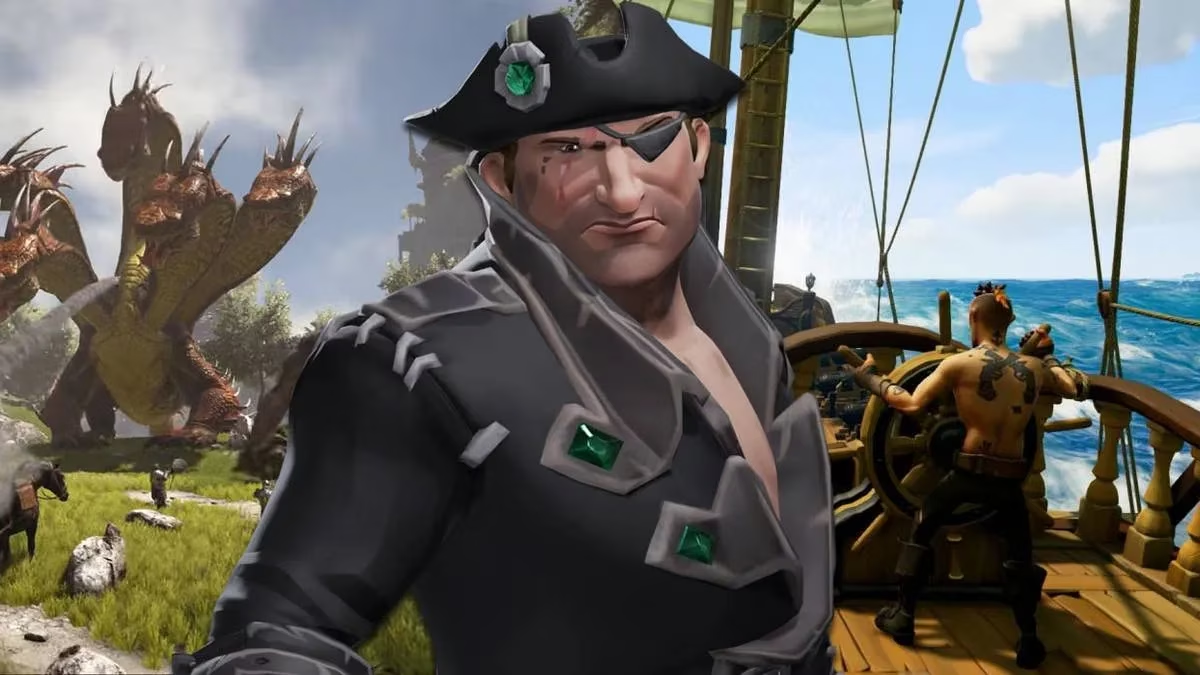
Here's how the two stack up heading into 2026:
| Sea of Thieves | Atlas | |
|---|---|---|
| Launch | March 2018 | December 2018 (early access) |
| Developer | Rare | Studio Wildcard |
| Status in 2026 | Actively updated live-service game | Effectively dormant |
| Platforms | Xbox, PC, PlayStation 5 | PC, Xbox |
| Player base | 40+ million lifetime players | A shadow of its launch numbers |
| Seasonal content | Yes, year after year | Rarely, if ever |
The contrast isn't subtle. One studio kept showing up. The other moved on to other projects.
Rare Kept Sailing
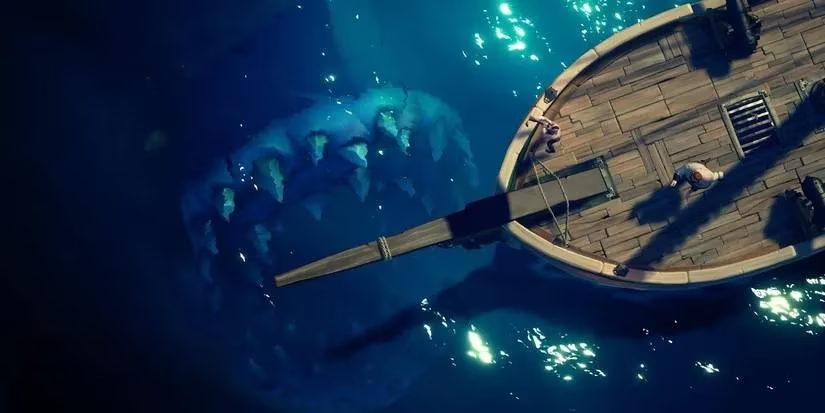
What makes the Sea of Thieves story so satisfying is that nobody expected it. Rare didn't panic and rebuild the game from scratch — the studio simply kept adding. Megalodons started hunting ships. Skeleton crews began patrolling the waves. Volcanoes erupted and rained fire on anyone careless enough to sail too close. Cursed cannonballs turned every fight into a puzzle of timing and trickery. Tall Tales gave solo players and story lovers a reason to explore every island.
Then came the structural stuff. Emissary flags gave crews a risk-and-reward loop that finally made hauling treasure feel tense. The seasonal model replaced the old content droughts with a steady drumbeat of updates. Safer Seas let players who hated PvP enjoy the world without being ambushed. And in 2024, Sea of Thieves finally broke free of the Xbox ecosystem and landed on PlayStation 5, bringing cross-play to an even bigger audience.
It also helps that Rare's attention is no longer split. With Everwild cancelled in 2025, the studio's future is squarely tied to its pirate sandbox — and that's genuinely good news for anyone who plays it.
Meanwhile, Atlas Drifted Into the Fog
Atlas never got the redemption arc. Studio Wildcard's energy shifted to ARK: Survival Ascended and the long-promised ARK 2, and Atlas was left bobbing in the water with little communication and fewer updates. It technically still exists, and the occasional dedicated crew still logs in, but the dream of a 40,000-player pirate MMO never materialised. The servers are quiet, the roadmap is a rumour, and the community that once filled forums with ship designs has mostly moved on.
It's a shame, honestly. The idea was great. The execution just never caught up.
So What Should a New Pirate Actually Do?
If someone is picking up a cutlass for the first time in 2026, the entry path is straightforward:
-
🗺️ Start with Tall Tales — they double as a tutorial for the whole map.
-
⚓ Run a few Gold Hoarder voyages to learn sailing, wind, and anchoring.
-
💀 Try a World Event once you've got a crew of two or three.
-
⚔️ Dip into Hourglass PvP only after you're comfortable in a fight.
-
🤝 Turn on Safer Seas if you'd rather just fish, dig, and explore.
The magic, though, isn't in the checklists. It's in the moments the game engineers by accident: a rival crew that could have sunk you deciding to help instead, a kraken appearing during a storm, a chest that turns out to be cursed and starts wailing. That unpredictability is what keeps players coming back, and it's exactly what Atlas never managed to deliver.
The Bottom Line
Atlas was a bet on scale. Sea of Thieves was a bet on iteration, and iteration won. Rare's game launched thin and grew fat on years of patient updates, while Studio Wildcard's pirate epic launched broken and quietly faded. In 2026, there's no real debate left to have — if the goal is to feel like a pirate, Sea of Thieves is where the ships are still sailing, the treasure is still buried, and the horizon keeps moving.